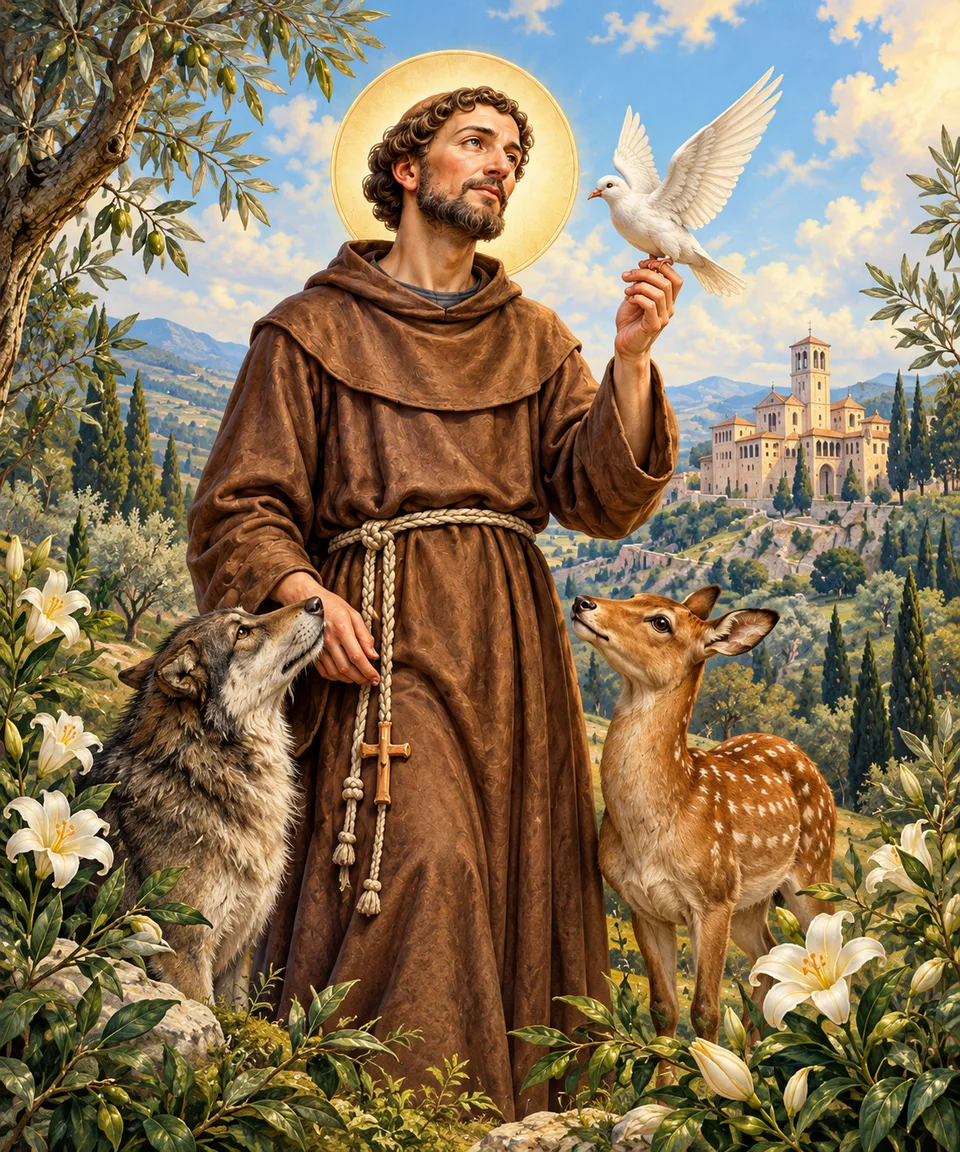
Korea’s first native Catholic priest, formed within a Church sustained by lay believers. His journeys across Asia connected communities living under persecution.
Explore at your pace, or play the story to move between chapters every 12 seconds.
Artistic illustration · ImageGen · A visual companion, not a reconstruction of events.
01 / 061821–1836
A Church sustained by lay people
Andrew was born at Solmoe on 21 August 1821 into a Catholic family. Korean Christianity grew through lay people who studied and transmitted faith before a stable priestly presence. This matters: Andrew was not the single founder of the Korean Church, but emerged from families and communities whose courage preceded him.
Artistic illustration · ImageGen · A visual companion, not a reconstruction of events.
02 / 061836–1844
Learning far from home
In 1836 he was selected for priestly formation and left for Macau with two other Korean young men. Distance, language and difficult travel shaped his studies. This education connected Korea with Asian mission networks while preparing him to return to his own people, at a time when entry into his homeland was severely restricted.
Artistic illustration · ImageGen · A visual companion, not a reconstruction of events.
03 / 061845
Korea’s first native priest
On 17 August 1845 Bishop Jean-Joseph Ferréol ordained Andrew in Shanghai. He returned to Korea for a brief but significant ministry. The ordination of a Korean priest meant local communities could be served by someone familiar with their language and lives; this work still depended on collaboration with lay believers and missionaries.
Artistic illustration · ImageGen · A visual companion, not a reconstruction of events.
04 / 061845–1846
Keeping fragile connections alive
Under persecution, meetings with believers required discretion. Andrew helped seek entry routes for missionaries and linked scattered communities. His witness presents ministry as a human network: letters, journeys and brief conversations could sustain hope when freedom to gather and worship was restricted. Faith was carried through these vulnerable relationships.
Artistic illustration · ImageGen · A visual companion, not a reconstruction of events.
05 / 061846
Arrest and martyrdom
Andrew was arrested while working on maritime connections. Following interrogation in Seoul, he was executed at Saenamteo on 16 September 1846, aged 25 by modern reckoning. Church sources remember him as a witness to faith; this story neither makes violence entertainment nor assumes that all Korean society opposed Christianity.
The Solmoe shrine complex in 2014, commemorating Andrew Kim’s birthplace. This is not the burial site at Mirinae.
Korea.net / Korean Culture and Information Service (Jeon Han) · CC BY-SA 2.0 · Photo source · 13 May 2014 · Resized and converted to WebP. The source license continues to apply.
06 / 061984–Today
Burial, birthplace and remembrance
John Paul II canonized Andrew with 102 other martyrs in Seoul on 6 May 1984. Mirinae is now recorded as his burial site. Solmoe commemorates his birthplace and was visited by Pope Francis in 2014. The sites serve different purposes: the atlas connects life, martyrdom and legacy without treating every place as a relic repository.
Andrew was born at Solmoe on 21 August 1821 into a Catholic family. Korean Christianity grew through lay people who studied and transmitted faith before a stable priestly presence. This matters: Andrew was not the single founder of the Korean Church, but emerged from families and communities whose courage preceded him.
In 1836 he was selected for priestly formation and left for Macau with two other Korean young men. Distance, language and difficult travel shaped his studies. This education connected Korea with Asian mission networks while preparing him to return to his own people, at a time when entry into his homeland was severely restricted.
On 17 August 1845 Bishop Jean-Joseph Ferréol ordained Andrew in Shanghai. He returned to Korea for a brief but significant ministry. The ordination of a Korean priest meant local communities could be served by someone familiar with their language and lives; this work still depended on collaboration with lay believers and missionaries.
Under persecution, meetings with believers required discretion. Andrew helped seek entry routes for missionaries and linked scattered communities. His witness presents ministry as a human network: letters, journeys and brief conversations could sustain hope when freedom to gather and worship was restricted. Faith was carried through these vulnerable relationships.
Andrew was arrested while working on maritime connections. Following interrogation in Seoul, he was executed at Saenamteo on 16 September 1846, aged 25 by modern reckoning. Church sources remember him as a witness to faith; this story neither makes violence entertainment nor assumes that all Korean society opposed Christianity.
John Paul II canonized Andrew with 102 other martyrs in Seoul on 6 May 1984. Mirinae is now recorded as his burial site. Solmoe commemorates his birthplace and was visited by Pope Francis in 2014. The sites serve different purposes: the atlas connects life, martyrdom and legacy without treating every place as a relic repository.
Korean sources sometimes give his age as 26 using traditional age reckoning. The dates 21 August 1821 and 16 September 1846 give an elapsed age of 25. Mirinae is the burial site reported by KTO; Solmoe is a birthplace and memorial, not a claim to his tomb.
Traces of a legacy
A legacy you can trace
Dangjin · South Korea
Solmoe Martyrs Shrine
Memorial site
The Solmoe shrine complex in 2014, commemorating Andrew Kim’s birthplace. This is not the burial site at Mirinae.
Korea.net / Korean Culture and Information Service (Jeon Han) · CC BY-SA 2.0 · Photo source · 13 May 2014 · Resized and converted to WebP. The source license continues to apply.
Andrew Kim Taegon’s birthplace shrine at Solmoe. Buildings and monuments commemorate his life; this point is a memorial site, not his burial location.
Korea Tourism Organization records Mirinae as Andrew Kim’s burial site, alongside his mother Ursula, Bishop Ferréol, and Vincentius Lee Minsik, who buried him.