Leader of the young pages at the Buganda court. His newly received faith became a source of strength for accompanying others through persecution at Namugongo.
Explore at your pace, or play the story to move between chapters every 12 seconds.
Artistic illustration · ImageGen · A visual companion, not a reconstruction of events.
01 / 06c. 1860/1861–1885
A young man from Buganda
Charles came from the Baganda people in the Buddu region. His setting was the kingdom of Buganda, before modern Uganda existed. At Kabaka Mwanga II’s court he led pages serving in the audience hall. That role placed other young people in his care, beyond his own daily duties.
Artistic illustration · ImageGen · A visual companion, not a reconstruction of events.
02 / 061885
Faith shared with others
Christian communities grew through teaching, encounters and local believers’ witness. Joseph Mukasa Balikuddembe was an important figure at court. After Joseph was killed on 15 November 1885, Charles received baptism that same day. His decision took place amid real danger, rather than a secure setting or an effortless journey.
Artistic illustration · ImageGen · A visual companion, not a reconstruction of events.
03 / 06May 1886
Accompanying younger companions
As persecution intensified, Charles did more than hold to his own belief. The shrine records his baptism of younger pages, including Kizito and Mugagga Lubowa, on 26 May 1886. Their stories highlight accompaniment: a leader can help more vulnerable people find courage and a sense of belonging.
Artistic illustration · ImageGen · A visual companion, not a reconstruction of events.
04 / 063 June 1886
Namugongo and martyrdom
Christians were taken to Namugongo and held before execution. Charles was separated from the group and killed by burning on 3 June 1886. This event is told without graphic scenes. The Church remembers their fidelity and courage, rather than treating suffering as a spectacle or a goal to pursue.
Artistic illustration · ImageGen · A visual companion, not a reconstruction of events.
05 / 061920–1964
Memory becomes a shared legacy
The martyrs were beatified in 1920, and Paul VI canonized the 22 Catholic martyrs on 18 October 1964. Their commemoration made African believers’ witness visible within the worldwide Church. During his 2015 visit, Pope Francis emphasized faith received, lived, and then passed on to other people.
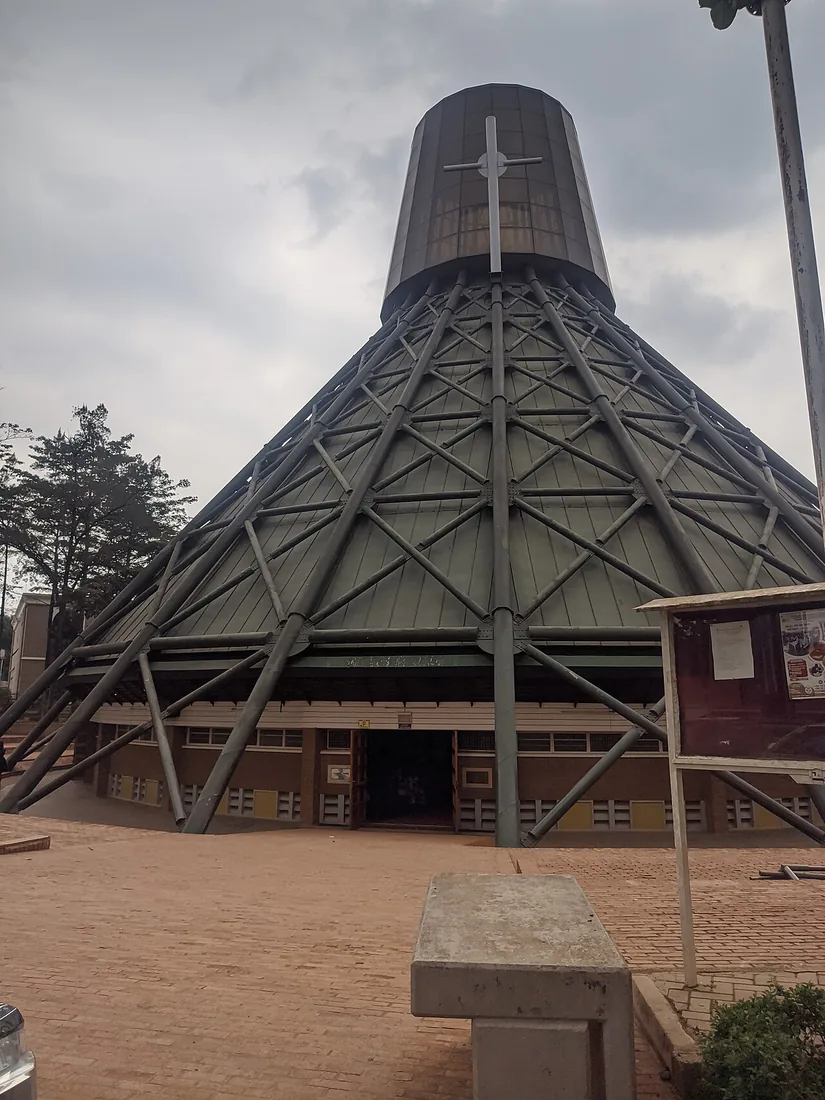
Uganda Martyrs Basilica at Namugongo, photographed in 2024. The building stands at Charles Lwanga’s martyrdom site.
Lebu Ayiga · CC0 · Photo source · 19 July 2024 · Resized and converted to WebP. The source license continues to apply.
06 / 06Today
Relics and a place of remembrance
Namugongo Basilica stands at the site associated with Charles’s martyrdom. Its custodian reports a bone fragment in glass at the front of the mahogany altar. This is a custodial attribution, not our biological examination. Architectural photographs introduce the setting; they do not establish the identity of the relic inside.
Charles came from the Baganda people in the Buddu region. His setting was the kingdom of Buganda, before modern Uganda existed. At Kabaka Mwanga II’s court he led pages serving in the audience hall. That role placed other young people in his care, beyond his own daily duties.
Christian communities grew through teaching, encounters and local believers’ witness. Joseph Mukasa Balikuddembe was an important figure at court. After Joseph was killed on 15 November 1885, Charles received baptism that same day. His decision took place amid real danger, rather than a secure setting or an effortless journey.
As persecution intensified, Charles did more than hold to his own belief. The shrine records his baptism of younger pages, including Kizito and Mugagga Lubowa, on 26 May 1886. Their stories highlight accompaniment: a leader can help more vulnerable people find courage and a sense of belonging.
Christians were taken to Namugongo and held before execution. Charles was separated from the group and killed by burning on 3 June 1886. This event is told without graphic scenes. The Church remembers their fidelity and courage, rather than treating suffering as a spectacle or a goal to pursue.
The martyrs were beatified in 1920, and Paul VI canonized the 22 Catholic martyrs on 18 October 1964. Their commemoration made African believers’ witness visible within the worldwide Church. During his 2015 visit, Pope Francis emphasized faith received, lived, and then passed on to other people.
Namugongo Basilica stands at the site associated with Charles’s martyrdom. Its custodian reports a bone fragment in glass at the front of the mahogany altar. This is a custodial attribution, not our biological examination. Architectural photographs introduce the setting; they do not establish the identity of the relic inside.
The shrine gives 1861 as his birth year; other biographies use about 1860. His birth is therefore shown approximately. The 22 Catholic martyrs of 1885–1887 are distinct from two catechists killed in 1918. Anglican martyrs are also remembered; their community identities are not merged into one canonization list.
Traces of a legacy
A legacy you can trace
Namugongo · Uganda
Uganda Martyrs Basilica, Namugongo
Location reported by institutional sources
Uganda Martyrs Basilica at Namugongo, photographed in 2024. The building stands at Charles Lwanga’s martyrdom site.
Lebu Ayiga · CC0 · Photo source · 19 July 2024 · Resized and converted to WebP. The source license continues to apply.
A basilica at the site of Charles Lwanga’s martyrdom. Its custodian identifies a bone fragment in glass at the front of the mahogany altar; the site also commemorates the Uganda martyrs.