Explore at your pace, or play the story to move between chapters every 12 seconds.
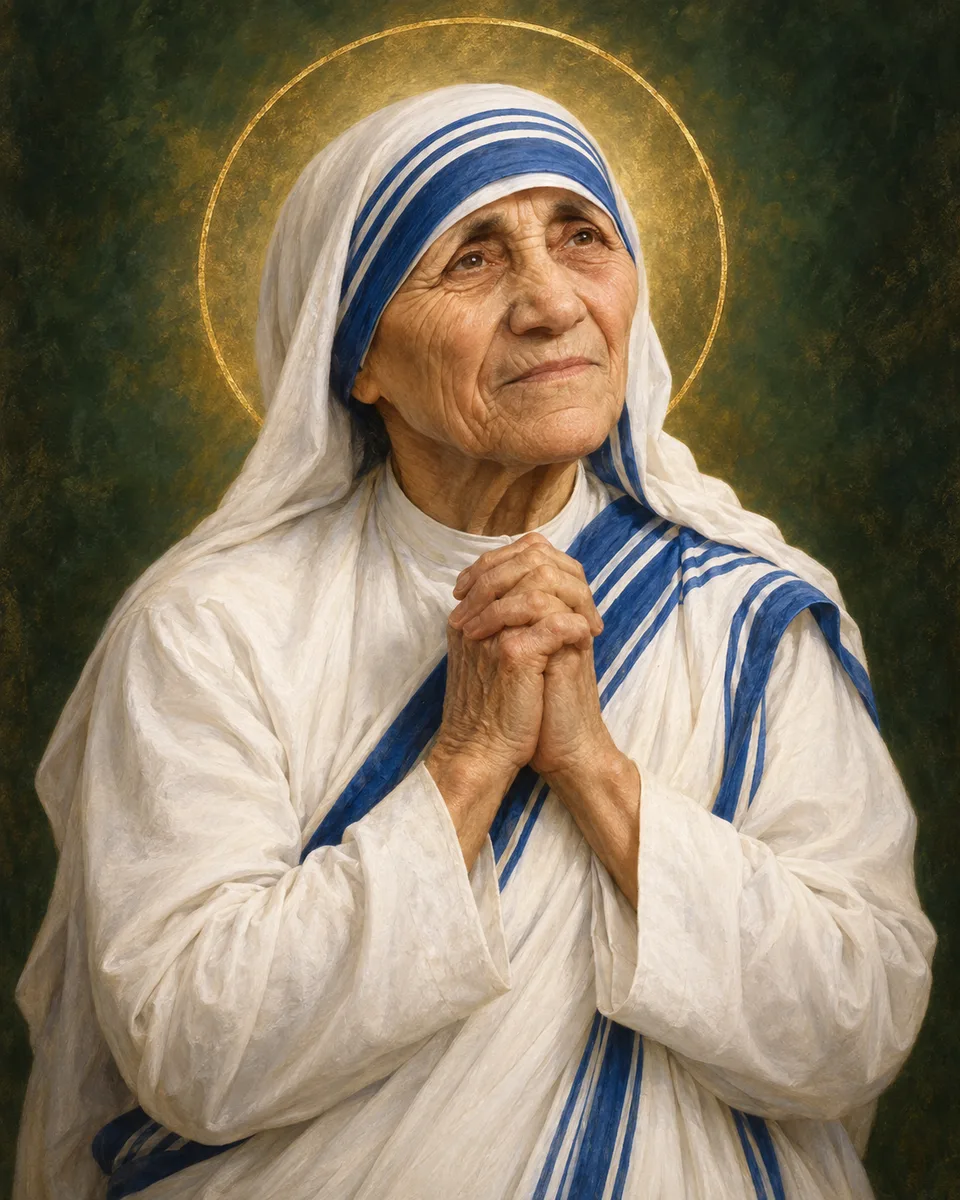
Artistic illustration · ImageGen · A visual companion, not a reconstruction of events.
01 / 061910–1928
Gonxha of Skopje
Gonxha Agnes Bojaxhiu was born on 26 August 1910 in Skopje, into an Albanian family. She later took the religious name Teresa. Names and migration show why one life may have several geographical connections that a single nationality label cannot fully express.
Artistic illustration · ImageGen · A visual companion, not a reconstruction of events.
02 / 061928–1944
Loreto and the years of teaching
She joined Loreto in Ireland in 1928 and arrived in India in 1929. Before founding the Missionaries of Charity, she taught and led a school. These years provide context for the experience in education, organisation and community life that preceded her street-level work in Kolkata.
Artistic illustration · ImageGen · A visual companion, not a reconstruction of events.
03 / 061946–1948
A call within a call
On a train to Darjeeling on 10 September 1946, she experienced what she called a call within a call. After permission and preparation, she began a new form of service in 1948. This is presented as her religious testimony, not an inner experience that an image can verify.
Artistic illustration · ImageGen · A visual companion, not a reconstruction of events.
04 / 061950–1953
A community takes shape in Kolkata
The Missionaries of Charity was established as a diocesan congregation on 7 October 1950. The Mother House became the community’s home in February 1953. These dates distinguish the congregation’s foundation, the use of the building and the development of its work.
Artistic illustration · ImageGen · A visual companion, not a reconstruction of events.
05 / 061950s–1990s
Service and a life with complexity
The community spread beyond India through service houses and different forms of membership. The Church’s biography also discusses Teresa’s inner struggle. Reading a saint’s life need not erase difficulties, questions or social context; respect for her work can accompany careful examination of sources.
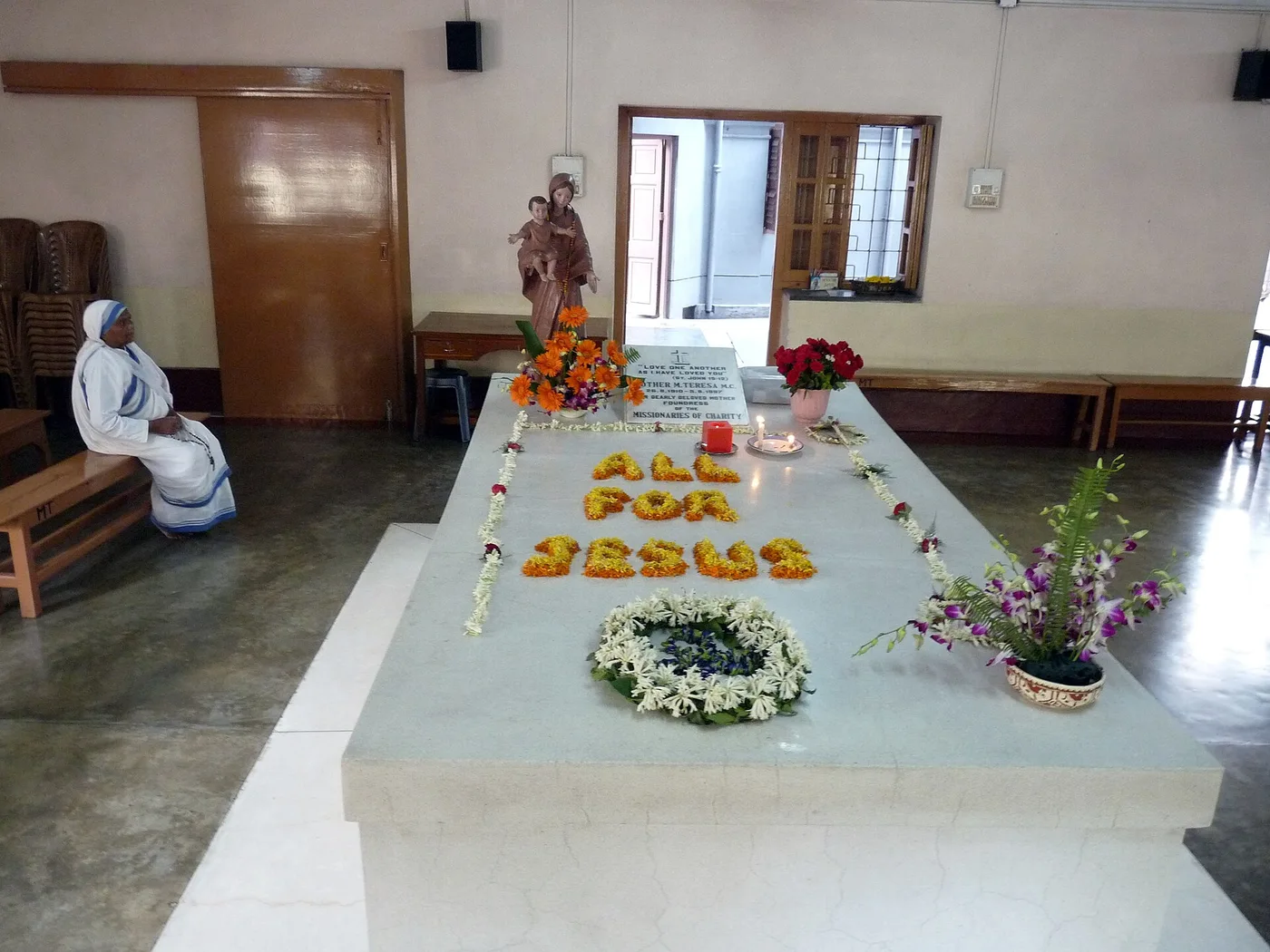
Teresa’s tomb at the Mother House, Kolkata. A visit photograph from 2010; the decoration may change.
Steve Browne & John Verkleir from Chicago, United States · CC BY 2.0 · Photo source · 3 November 2010
06 / 061997–2016
Tomb, room and museum
Teresa died on 5 September 1997 and was buried at the Mother House on 13 September. Her room and the museum provide context for daily life beyond the tomb. Canonization took place on 4 September 2016. Older photographs need to be read alongside the custodian’s location reports.
Gonxha Agnes Bojaxhiu was born on 26 August 1910 in Skopje, into an Albanian family. She later took the religious name Teresa. Names and migration show why one life may have several geographical connections that a single nationality label cannot fully express.
She joined Loreto in Ireland in 1928 and arrived in India in 1929. Before founding the Missionaries of Charity, she taught and led a school. These years provide context for the experience in education, organisation and community life that preceded her street-level work in Kolkata.
On a train to Darjeeling on 10 September 1946, she experienced what she called a call within a call. After permission and preparation, she began a new form of service in 1948. This is presented as her religious testimony, not an inner experience that an image can verify.
The Missionaries of Charity was established as a diocesan congregation on 7 October 1950. The Mother House became the community’s home in February 1953. These dates distinguish the congregation’s foundation, the use of the building and the development of its work.
The community spread beyond India through service houses and different forms of membership. The Church’s biography also discusses Teresa’s inner struggle. Reading a saint’s life need not erase difficulties, questions or social context; respect for her work can accompany careful examination of sources.
Teresa died on 5 September 1997 and was buried at the Mother House on 13 September. Her room and the museum provide context for daily life beyond the tomb. Canonization took place on 4 September 2016. Older photographs need to be read alongside the custodian’s location reports.
Teresa formed a community to sustain service. How does a personal action change when it becomes an institution’s responsibility? Consider shared work, rules and attention to those receiving care.