Explore at your pace, or play the story to move between chapters every 12 seconds.
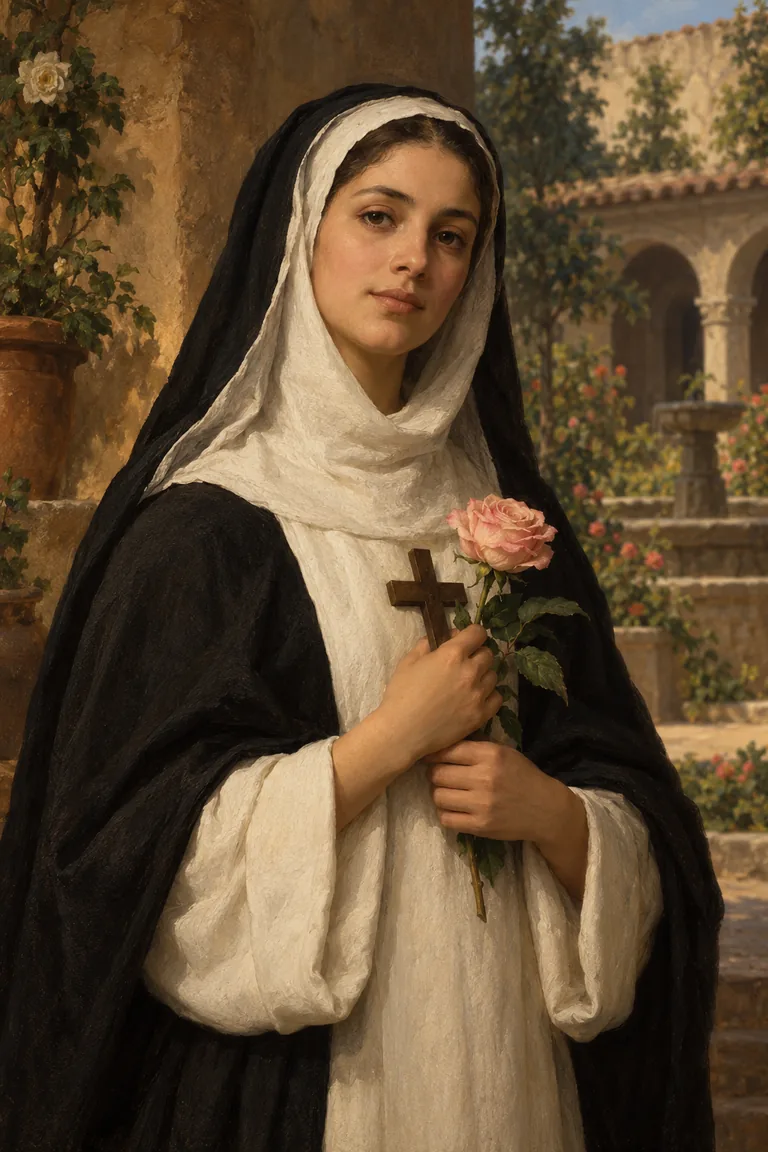
Artistic illustration · ImageGen · A visual companion, not a reconstruction of events.
01 / 061586–1606
Isabel in colonial Lima
Rose was born in Lima in 1586 as Isabel Flores de Oliva. The childhood name Rosa later became the best-known form of her name. She lived in a colonial city marked by social inequality and encounters among diverse groups. That setting helps us understand personal service alongside surrounding poverty and power structures.
Artistic illustration · ImageGen · A visual companion, not a reconstruction of events.
02 / 06Youth
Work for family and neighbours
When her family’s finances worsened, Rose worked in gardening and embroidery. Available earnings and labour supported both family life and service. Her story shows that spiritual life did not unfold apart from everyday work: hands tending soil and making crafts could also be hands offering help to other people.
Artistic illustration · ImageGen · A visual companion, not a reconstruction of events.
03 / 061606
The path of a lay Dominican
In 1606 Rose took the habit of the Third Order of Saint Dominic. Inspired by Catherine of Siena, she lived her calling as a lay woman within her family’s setting. Dominican tradition offered a way to unite prayer, learning and service without requiring everyone to share the same form of enclosed religious life.
Artistic illustration · ImageGen · A visual companion, not a reconstruction of events.
04 / 061609–1617
Silence open to other people
Rose used a small hermitage in the family garden for prayer. Sources also remember care for children, older people and poor neighbours at her home. Silence and concern for others were not separated. Severe ascetical practices in her biography require their seventeenth-century context, rather than serving as instructions to imitate bodily harm.
Artistic illustration · ImageGen · A visual companion, not a reconstruction of events.
05 / 061617–1671
From grief to veneration
Rose died on the night of 23–24 August 1617. Public veneration continued through Church processes: beatification in 1668 and canonization by Clement X in 1671. She is known as the first canonized saint born in the Americas. That title records formal recognition, while her legacy remains rooted in service in Lima.
Interior of Santo Domingo Church in Lima, photographed on 28 July 2015. This Dominican complex preserves the legacies of Peruvian saints.
Diego Delso · CC BY-SA 4.0 · Photo source · 28 July 2015 · Resized and converted to WebP. The source license continues to apply.
06 / 06Today
Tracing the relics in Lima
The Santo Domingo convent museum identifies relic chapels and a crypt containing Rose’s remains. The complex also preserves the legacies of Martin de Porres and Juan Macías. The Santa Rosa birthplace sanctuary is a separate site. Church photographs show the heritage setting; relic attributions follow custodians rather than biological testing by this website.
Rose was born in Lima in 1586 as Isabel Flores de Oliva. The childhood name Rosa later became the best-known form of her name. She lived in a colonial city marked by social inequality and encounters among diverse groups. That setting helps us understand personal service alongside surrounding poverty and power structures.
When her family’s finances worsened, Rose worked in gardening and embroidery. Available earnings and labour supported both family life and service. Her story shows that spiritual life did not unfold apart from everyday work: hands tending soil and making crafts could also be hands offering help to other people.
In 1606 Rose took the habit of the Third Order of Saint Dominic. Inspired by Catherine of Siena, she lived her calling as a lay woman within her family’s setting. Dominican tradition offered a way to unite prayer, learning and service without requiring everyone to share the same form of enclosed religious life.
Rose used a small hermitage in the family garden for prayer. Sources also remember care for children, older people and poor neighbours at her home. Silence and concern for others were not separated. Severe ascetical practices in her biography require their seventeenth-century context, rather than serving as instructions to imitate bodily harm.
Rose died on the night of 23–24 August 1617. Public veneration continued through Church processes: beatification in 1668 and canonization by Clement X in 1671. She is known as the first canonized saint born in the Americas. That title records formal recognition, while her legacy remains rooted in service in Lima.
The Santo Domingo convent museum identifies relic chapels and a crypt containing Rose’s remains. The complex also preserves the legacies of Martin de Porres and Juan Macías. The Santa Rosa birthplace sanctuary is a separate site. Church photographs show the heritage setting; relic attributions follow custodians rather than biological testing by this website.
What work could become care today? Choose a concrete small action: preparing a meal, keeping a sick person company, or helping a neighbour without seeking attention.
Sources place her death on the night of 23–24 August 1617; 24 August is the usual date. The universal memorial on 23 August differs from Peru’s celebration on 30 August. Mystical and miracle accounts belong to devotional tradition. Santo Domingo, the birthplace sanctuary, and the Santa Rosa monastery are distinct places.
Traces of a legacy
A legacy you can trace
Lima · Peru
Basílica y Convento de Santo Domingo, Lima
Location reported by institutional sources
Interior of Santo Domingo Church in Lima, photographed on 28 July 2015. This Dominican complex preserves the legacies of Peruvian saints.
Diego Delso · CC BY-SA 4.0 · Photo source · 28 July 2015 · Resized and converted to WebP. The source license continues to apply.
A Dominican complex whose custodian identifies relics and remains of Rose of Lima. The museum includes the Peruvian saints’ chapels and Rose’s crypt in its visitor route.